Looks like a mercury vapour lamp - actually reminds me of the projector UHP lamp spectrum. In Incandescents yellow/orange/red should absolutely dominate. Maybe limitation/inaccuracy of the spectrometer ?
Projector UHP bulb spectrum example: 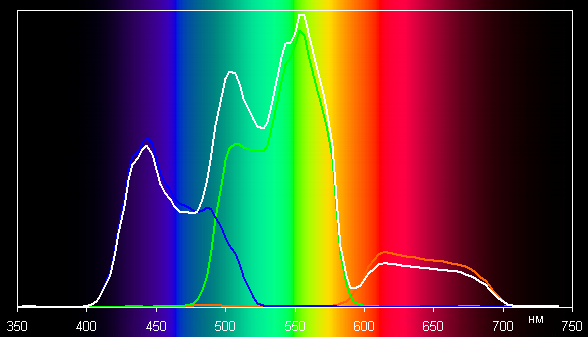
Halogen (incandescent): 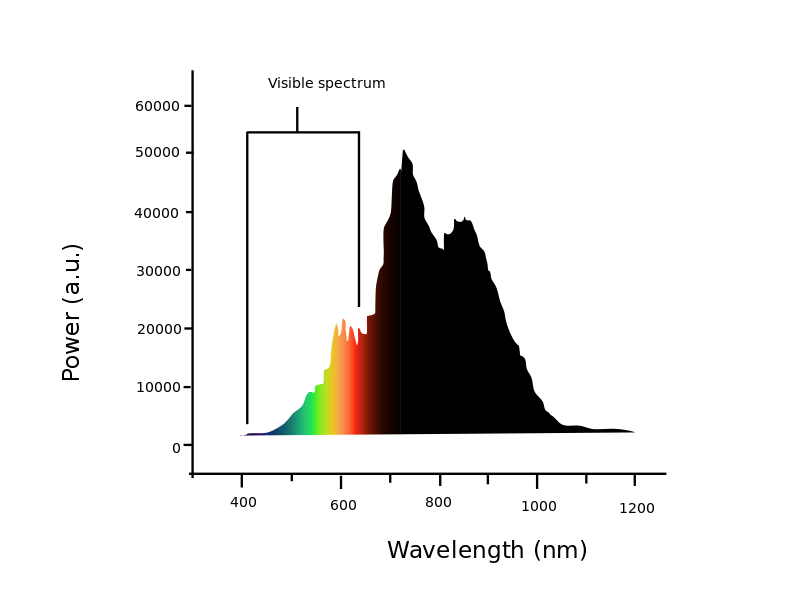
Seagull My thinking also, I will try to balance the spectrum with colour filter overlays and see if my tolerance to them improves.
While I'm interested in results of such experiment, I must say that in theory filling the LCD screen with red colour should produce the same results. I personally don't find it tolerable - the full red or green gives the same strain (not sure if less or more). Although maybe external color filter will do better filtering so worth trying. BTW it would be interesting to measure the spectrum of red (and green) screen, would there be detectable blue peak or other pecularities..?
Just as we're discussing spectrum part of screens - I disassembled LCD display recently and must say that LCD panel itself is quite opaque even in white (open state) - 60W incandescent lamp barely penetrates it. The LED backlight is extremely bright and has quite unpleasant violetish tint (I almost fell of the chair when accidentally enabled the disassembled screen 🙂). So if there's some parasite spectrum part that is invisible and is not filtered by the LCD panel, there can be enough of it to produce straining effect for sensitive people. But then, something like computer screen glasses should help, as they have UV filter etc., which is not the case for me.

